Gender

Adopting an integrated approach to women's rights, one that recognises the indivisibility of civil-political and socio-economic rights- we have aimed to produce cutting edge theoretical and policy frameworks on gender equality in the information society. Our research and advocacy are rooted in Southern feminist approaches to women's digital age citizenship, rejecting glib, one-size-fits-all approaches.

RECENT

Mainstream AI models reflect patriarchal power structures rather than enabling feminist futures. The project of feminist AI, therefore, is not just about building representative or fair AI tools, but radically transforming AI innovation trajectories for structural justice. 

Against this backdrop, IT for Change is pleased to support the…

This think piece was written by Gabriella Razzano as part of our ‘Re-wiring India's Digitalising Economy for Women's Rights and Well-being’ project, supported by Friedrich-Ebert-Stiftung (FES) and the European Union.

Digital inequality in Africa is profoundly gendered, with women facing particular exclusions and risks from the emerging…
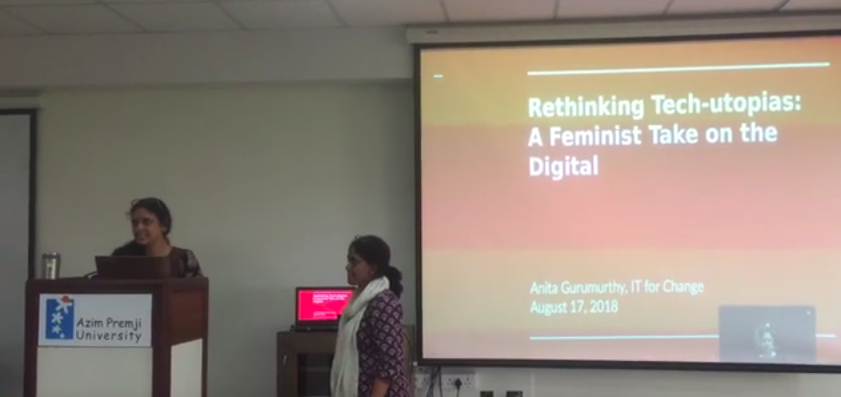
IT for Change, with support from the International Development Research Centre and the Center for Global Digital Justice, invites applications from South and Southeast Asia to join the FemFirst Lab. This initiative is part of the Inclusive AI Research Network.

Objective

To incubate feminist AI prototypes that seek to address challenges…

As part of the ‘Re-wiring India’s Digitalising Economy for Women’s Rights and Well-being' project, we invited proposals for the second edition of the National Gender Fellowship. Facilitated by the European Commission and Friedrich-Ebert-Stiftung, the fellowship supports early-career scholars, researchers, and practitioners, in the development…

Prakriye and Hosa Hejje Hosa Dishe are our two field projects leveraging digital technologies towards empowering women and girls from marginalized contexts. 

With a history of 20+ years, the Prakriye project has been working with women and girls across rural Mysuru. Through women-led community information centres, and forums, these…

This think piece was written by Karin Fernando and Chandima Arambepola as part of our ‘Re-wiring India's Digitalising Economy for Women's Rights and Well-being’ project, supported by Friedrich-Ebert-Stiftung (FES) and the European Union.

Supply chains linked to manufacturing have been instrumental in…